
SSCLE Awards Best Book Prize 2026
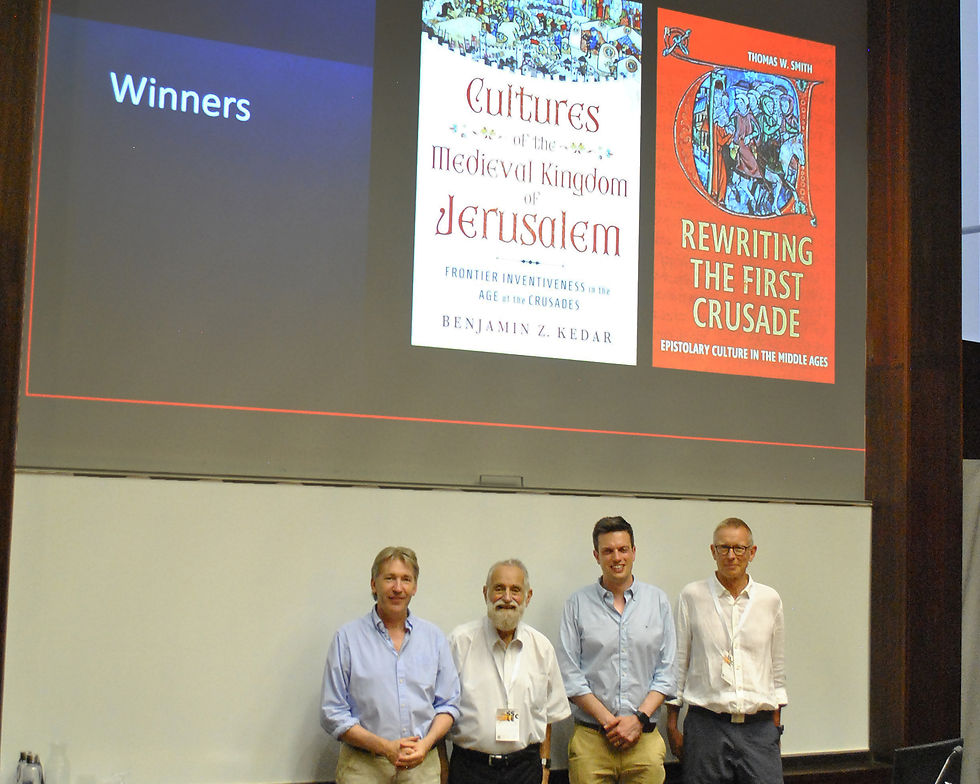
(The following remarks were given by Christoph Maier, chair of the prize committee, at the 2026 SSCLE Porto Conference. They have been lightly edited for the web)
Dear members of the SSCLE. It is my pleasure as chair of the committee for the Best Book Prize to present the result of the 2026 competition for books published in the past four years between the last and this conference of the SSCLE. I would like to warmly thank the other members of the prize committee for their considerate and laborious work in assessing the books under consideration. They are Elizabeth Siberry, Carol Sweetenham and Kurt Villads Jensen, and Peter Edbury.
The shortlist for this year’s Best Book Prize included a diverse choice of seven books by altogether eight authors from six different countries, three female and five male. The seven books represent three different languages and were published by six publishers from five different countries. Such is the diversity in the field of crusade studies if proof were needed.
All seven short-listed books are prizeworthy in their own right, and the committee’s task was not made easy for it. In order to acknowledge the enormous range and quality of the entries, we have decided to award the prize jointly to the authors of the following two books. Thanks to the generosity of the SSCLE both books will be awarded the full prize money. They are:
Benjamin Z. Kedar, Cultures of the Medieval Kingdom of Jerusalem: Frontier Inventiveness in
the Age of the Crusades, Cornell University Press, 2025.
Thomas W. Smith, Rewriting the First Crusade: Epistolary Culture in the Middle Ages, The
Boydell Press, 2024.
Benjamin Kedar’s Cultures of the Medieval Kingdom of Jerusalem draws on a lifetime of research and provides a distillation of the author’s life’s work. It testifies to the enormous range of his scholarship, and he brings a freshness to his subject matter which avoids repeating clichéd generalisations. The subject matter is varied, from beards and bathhouses to libraries and individual kings and includes not just the perspectives of the Franks but also of other communities such as the Jews and Samaritans. It expertly tells the story of the Kingdom of Jerusalem with close reference to the sources and with great understanding for the challenging conditions of a frontier society and the intricacies of cross-cultural encounters and exchanges. The book presents a splendid synthesis, enormously rich, reflective and informative, iconoclastic as well as challenging.
No one studying the First Crusade can ignore Thomas Smith’s Rewriting the First Crusade. Tom Smith has subjected the letters written in the context of the First Crusade to rigorous scrutiny, discovered hitherto overlooked manuscripts, and provided a cogent and well-constructed critique of each letter in turn. The scholarship is impeccable and the arguments are presented lucidly and persuasively. His forensic analysis looks at these key sources with a fresh eye, informed by a detailed knowledge and understanding of the manuscript material and the context in which it was produced. The book highlights how the recipients used the letters to reshape the narrative of events, reflecting the developing reception of the crusade amongst crusaders, their networks and European ecclesiastical communities. This book provides a major innovative contribution to crusade studies which will shape our future understanding of the events and impact of the First Crusade.
Many congratulations to the two authors!
-Christoph Maier

